Category: Harm Reduction

  • Harm Reduction Comes of Age in Canada, or Does It?

    Harm Reduction Comes of Age in Canada, or Does It?

    This post first appeared in the Centre for Addictions Research of BC’s blog Matters of Substance.

    The Supreme Court of Canada’s September 2011 decision allowing Vancouver’s supervised injection site, Insite, to keep operating was a critical milestone for harm reduction in Canada.

    One only has to look at the list of interveners in the case in support of this innovative service to see that it has become a valued and mainstream service in Canada. Canadian health organizations including the Canadian Medical Association, Canadian Nurses Association, Canadian Public Health Association and 11 others saw fit to come before the court to support Insite. But even with this high level of support, scaling up harm-reduction services in Canada remains a challenge.

    Harm reduction gained traction as a result of the HIV/AIDS crisis in the early 1980s and played a critical role as a strategy to engage injection-drug users in HIV prevention. Harm reduction’s more recent challenges have elevated the critique of policy-related harms – harm caused by policies that criminalize people who use illegal drugs.

    Harm reduction acknowledges that there are significant risks associated with illegal drugs and also attempts to work towards mitigating harms within the criminalized environment where drug use occurs. This often puts the public-health goals of engaging people who use drugs in conflict with traditional public-safety strategies that rely on disruption of illegal drug markets, and in turn disruption of the lives of people who use illegal substances.  Harm-reduction approaches balance these realities and focus on creating safer environments as much as possible within a context of criminalization. Some examples include promoting supervision of consumption or discouraging using drugs while alone, promoting rapid response strategies in the form of peer-delivered naloxone programs and strategies that work towards achieving a kind of détente between health efforts and enforcement practices. Given the context of criminalization, a key goal of harm reduction is to maximize the benefits of public-health interventions and minimize the harm of drug use and the enforcement of drug policy.

    So what should Canada be doing to facilitate the development of a more robust harm reduction approach as a part of a comprehensive response to drug use? We urge governments to begin with a review of current drug policies to determine the benefits and harms to individuals and communities that accrue from the criminalization of drugs and the people who use them.

    Other countries have done such an analysis and have decided to eliminate criminalization as a response to possession of drugs for personal use in an effort to maximize the benefit of a public-health approach to drug problems. Portugal (2001) and the Czech Republic (2009), are two examples of jurisdictions that have taken this step. Both have decriminalized all drugs that are deemed to be for personal use. Portugal decriminalized drugs as part of a response to an HIV epidemic and high rates of drug overdose. The Czech Republic did the same as a result of an extensive evaluation of the previous policy of criminalization. Evaluation of the experience in Portugal has shown that results have been positive overall – HIV incidence and overdose deaths have been reduced, police are supportive of the new law as it has given them more meaningful and helpful involvement in steering individuals towards health services, more people are accessing treatment and other health services which were improved as a part of the decriminalization policy. Additionally no negative trends have been seen in terms of increased harms attributed to this policy change.

    Achieving a policy shift as significant as decriminalization will take some time. In the meantime, the Canadian Drug Policy Report, Getting to Tomorrow, outlines some possibilities for improving the development of harm reduction in Canada in the short term:

    • Acknowledge that harm reduction is much more than supply distribution and is an essential component of a comprehensive public health response to problematic substance use that offers client-centred strategies with health engagement at their core.
    • Acknowledge that harm reduction values the human rights of people who use drugs and affirms that they are the primary agents of change for reducing the harms of their drug use.
    • Provincial governments can commit to articulating harm reduction strategies across mental health, addictions and infectious disease policy frameworks.
    • Where harm reduction language is present within policy frameworks ensure implementation at the community level.
    • Support innovation at all levels. An ethic of experimentation will help create an environment where new ideas and novel approaches can be developed and explored.
    • Provide leadership to bring health and policing agencies together to get “on the same page” with regard to harm reduction. Opposition by some in the policing community is unfortunate and an unnecessary barrier to scaling up harm reduction programs.

    Developing a robust and equitable harm-reduction approach for Canadians will necessitate new thinking about old strategies — thinking that exposes the harms that flow directly from our current policy frameworks and will open the door to new ideas and approaches that are emerging around the world.


  • The Road to 2016 – Drug Policy Consensus Shattered

    The Road to 2016 – Drug Policy Consensus Shattered

    There’s a Crack in Everything – That’s How the Light Gets In (with thanks to Leonard Cohen)

    I couldn’t help it. Sometimes my mind would wander while attending the Commission on Narcotic Drugs (CND) meeting in Vienna – the annual drug policy palooza where UN member states gather to shore up the failed prohibitionist policies of the past. Even an unanticipated Russell Brand appearance could do only so much to enliven the sessions.

    In those mind-wandering moments, I found myself humming Leonard Cohen’s famous song “Anthem,” especially the beautiful line: “There’s a crack in everything, that’s how the light gets in.”

    I suppose my mind wasn’t so much wandering, as it was synthesizing the stark disconnect between the evidence presented at the outset of the meeting – in fact, the science at the heart of the enterprise – and the actual decisions arrived at by CND delegates.

    There is unquestionably a crack in the consensus in these global discussions, a crack that may well end up being a chasm as wide as the Grand Canyon by the time the UN Special Session on Drugs (UNGASS) takes place in 2016 in New York.

    Decriminalization

    As for the light, that came in part from the two stellar UN-appointed scientific panels that reported out at the beginning of the meeting. Michel Kazatchkine, UN Envoy to Eastern Europe and Asia on HIV, and Nora Volkow, Director of the US National Institute on Drug Abuse, chaired panels that delivered strong statements on the need for problematic drug use to be dealt with as a public health issue not a criminal issue. Kazatchkine’s group noted: “Criminalization of drug use, restrictive drug policies and aggressive law enforcement practices are key drivers of HIV and Hepatitis C epidemics.” Volkow’s group added: “We consider that criminal sanctions are not beneficial in addressing substance use disorders and discourage their use.”

    The divide between the above statements and the content of the negotiations at the CND was vast – the overwhelming majority of delegates clung to the status quo and refused to even consider language on decriminalization. Clearly we’ve made very little progress since Portugal (2001) and the Czech Republic (2009) decriminalized all drugs for personal use, on their own without fanfare or bringing it up at the CND.

    Harm Reduction

    In a somewhat Orwellian turn of language control, a number of countries including Canada demanded the words ‘harm’ and ‘reduction’ not appear side by side, but they could endorse “measures aimed at minimizing the negative public health and social impacts of drug abuse that are outlined in the WHO, UNODC, UNAIDS Technical Guide.”

    Harm reduction, in other words.

    These programs are the most cost effective way to engage people who use drugs and often the only bridge to more mainstream public health services. The scientific panel offered clear statements on the benefits and cost-effectiveness: “Harm reduction interventions are good value for money, with average costs per HIV infection averted ranging from $100 to $1,000.”

    Apparently scientists can use the words, but not the members of the CND.

    Death Penalty

    Switzerland, with support from others, pushed hard at the meeting for the Joint Ministerial Statement to clearly state the death penalty was not an appropriate response to drug offenses of any kind. In the end they failed, being blocked by countries like Iran, China and a number of other Middle Eastern and Asian countries. Canada’s silence on this discussion was deafening.

    The Swiss allowed the “consensus” document to go forward but not without delivering the following statement at the end of the meeting:

    “The death penalty is in opposition to our position with regard to all offences. The International Covenant on Civil and Political Rights says that it should only be applied for very serious crimes and therefore very rarely. The human rights committee says we should very much limit the use of the death penalty. The International Narcotics Control Board (INCB) said that its application was never in the spirit of the (drug) conventions. The INCB encourages countries to consider its abolition. In this background, the silence of the Joint Ministerial Statement (JMS) on the death penalty is regrettable. It does not take into account our position and that of other (UN) bodies. We will continue to promote the abolition of the death penalty. We ask that our agreement with the JMS is on this understanding – capital punishment is not in line with our commitment to combat the world drug problem. International cooperation on drug law enforcement is contingent to respect for all human rights – as well as the right to life.”

    2016 UN General Assembly Special Session on Drugs (UNGASS)

    If there’s one thing that we learned while attending the CND it’s that any meaningful consensus on new approaches to addressing drug problems globally will be near impossible to attain when the biggest international drug policy meeting in 20 years – UNGASS 2016 – takes place in two years at the UN General Assembly in New York.

    This meeting was called in response to the pleas from the presidents of Mexico, Colombia and Guatemala a little over a year ago, calling on the UN to facilitate real dialogue on alternative approaches to the global drug problems.

    UNGASS is huge because it will undoubtedly precipitate a new approach to drug policy – either through the development of a more progressive global consensus, or, more likely, because it will shatter the distorted idea that a global consensus is possible.

    Either way, countries should be free to chart their own appropriate path forward to address drug problems, grounded in the public health and human rights imperatives enshrined in various UN conventions, without the shackles of the misguided and restrictive drug control treaties.

    “Ring the bells that still can ring
    Forget your perfect offering
    There is a crack in everything
    That’s how the light gets in.”
    – Leonard Cohen, Anthem

  • Treat drug use as a public health issue, not criminal issue, say UN agencies

    Treat drug use as a public health issue, not criminal issue, say UN agencies

    Criminal activity and drug trafficking. Distressingly, those are dominant discussion points at this week’s annual UN drug policy conference – the Commission on Narcotic Drugs (CND).

    As a result, public health considerations have been somewhat sidelined, but not, thankfully, among UN agencies, where a number of key representatives called for the removal of criminal sanctions associated with drug use, and the realignment of drug use as a public health issue.

    Back in Canada, the federal government is considering changing Canada’s marijuana laws to allow ticketing by police instead of arrest, but Justice Minister Peter MacKay has insisted that even if that’s the case, “Criminal Code offences would still be available to police…. It’s not decriminalization. It’s not legalization.” What’s more, the move could be a step backwards if police begin issuing tickets, where in the past they might have turned a blind eye.

    Regardless, under the current regime, simple cannabis possession charges in Canada numbered 61,406, a rate of 178 per 100,000 people as recently as 2011. This represented a 16% increase of such incidents since 2001. In BC alone, the arrest and prosecution of personal marijuana use costs taxpayers $10.5 million a year.

    Contrast that criminalization framework with comments from UN agencies this week at the CND:

    • UN Deputy Secretary Jan Eliasson tried to set a positive tone early by emphasizing the “public health imperative” in addressing drug use, and called for a “comprehensive and open-minded exchange” that included civil society input and that didn’t shy away from “discussing innovative ideas and perspectives.” He concluded by stressing that it is not enough to say no to drugs, “we are also saying yes… to human rights.”
    • Gilberto Gerra, Chief of Drug Prevention and Health Branch for the UN’s drug control agency (UNODC) insisted that criminal sanctions are ineffective and counter-productive because they do nothing to address problematic drug use. He argued that drug policies should be based on health and not on punishment, and that nowhere do international drug conventions require that personal use should be criminalized.
    •  Two Scientific Working groups convened by the UNODC to advise the CND criticized criminal sanctions and implored delegates to base their policy decisions on science.The first – headed by Nora Volkow (Director of the United States National Institute on Drug Abuse) – insisted that “substance use disorders should be treated as medical and public health issue rather than a criminal justice and/or moral issue.” Imprisonment does not equate with treatment, and the group discouraged the use of “criminal sanctions” given that they “are not beneficial in addressing substance use disorders.”
      The second group – headed by Michel Kazatchkine (UN Secretary General’s Special Envoy on HIV/AIDS for Eastern Europe and Central Asia) – concluded that “we need to stop incarceration of people who use drugs for minor drug related offenses.” Its members highlighted the legal and regulatory impediments to implementing harm reduction initiatives and noted that the “criminalization of drug use, restrictive drug policies and aggressive law enforcement practices are key drivers of HIV and hepatitis C epidemics among people who inject drugs.” Basically, people are dying because they are treated as criminals rather than patients.
    • UNAIDS director Michel Sidibe echoed calls to understand drug use as a public health and human rights issue, stating: “The criminalization of millions of people for minor drug offences exacerbates vulnerability to HIV infection, and does little to protect society from the health and social harms caused by drug dependence.” He added, “We must work towards transforming laws and law enforcement officials to become bridges to connect people who use drugs to life saving health services.”
    • The UN High Commissioner for Human Rights Navi Pillay’s statement drew attention to “the intense focus of law enforcement against drug use” which “has resulted in large numbers of persons being arrested and held in prolonged periods of pre-trial detention for minor drug offences.” She condemned the “so-called ‘treatment’ in such centres” which “is frequently not based on individualized assessment and evidence-based medical practice, but rather in mass treatment with a focus on disciplinary-type interventions.”

    These comments represent a striking scientific consensus on the harm created by the criminalization of drugs and those who use them. Clearly the language of public health is beginning to inform the deliberations at this forum. The real challenge for countries to put teeth into these recommendations by implementing concrete and comprehensive public health approaches to drug related harm.

  • World Aids Day 2013: If our goal is zero, drug policy reform is crucial

    World Aids Day 2013: If our goal is zero, drug policy reform is crucial

    Zero New HIV Infections. Zero Discrimination and Zero AIDS-related deaths. That is the goal set by UNAIDS over the next two years. But when it comes to stopping HIV transmission associated injection drug use, we have a long way to go.

    “An effective AIDS response among people who inject drugs is undermined by punitive policy frameworks and law enforcement practices” (UNAIDS 2013)

    The 2013 UNAIDS Global report notes that HIV prevalence among people who inject drugs ranged from 5% in Eastern Europe to 28% in Asia.  Rates of HIV among drug injectors in Canadian cities range from approximately 5% to more than 30%. According to Canada’s own Public Health Agency, more than 50% of new HIV infections among Aboriginal people in Canada were caused by intravenous drug use. Rates of HIV and hepatitis C among people incarcerated behind the walls of Canada’s prisons are 10 to 30 times outside those same walls. Although Corrections Canada claims that injection drug use is strictly prohibited within its facilities, no prison system in the world is able to keep drug use out.  But only two of 32 reporting countries surveyed by UNAIDS provided adequate access to sterile syringes for persons who injects drugs in prison.

    In 2012 the Global Commission on Drug Policy released a groundbreaking report titled “The War on Drugs and HIV/AIDS: How the Criminalization of Drugs Fuels THE Global Pandemic.” The report points to the inability of law enforcement to reduce global drug supply and raises the alarm about the role that repressive drug control policies play in driving the HIV epidemic in many regions of the world. The report also details how policies that prohibit needle distribution result in increased syringe sharing.  In fact the Global Commission confirms what others have been saying: the fear of arrest drives people underground and away from needed services. Together these repressive policies help to escalate HIV infections. The Commission urges countries to make available proven drug treatment and harm reduction services, to reduce HIV infection and protect community health and safety.

    It’s clear that ending prohibition and scaling up harm reduction is an integral part of solving the complex global HIV problem. By drawing on the evidence of what works, British Columbia has made significant strides at reducing infection rates, but our federal government willingly refuses to acknowledge the role that harm reduction plays in protecting everyone’s health.

    On September 30, 2013, the second anniversary of the Supreme Court of Canada decision that instructed the Canadian government to issue a permit for the supervised injection site, Insite in Vancouver, we worked with the Canadian HIV/AIDS Legal Network and PIVOT Legal Society to register our concerns to Health Minister Ambrose about attempts by the federal government to block the implementation of life-saving health services for people with addictions, in the face of extensive scientific evidence of their benefits in protecting public health and public safety. Our letter  to Ambrose, which garnered the support of more than 50 organizations in Canada, challenged her government to get going on life-saving harm reduction services. We are still waiting for a response.

    Along with our commitment to World Aids Day, we will also continue to mark September 30 (9-30), the anniversary of the Supreme Court decision supporting Insite. We invite you to join us and help ensure that supervised consumption services become a part of the continuum of care for people who use drugs in Canada. And finally, please consider contributing to help our small but mighty team continue to work for evidence based and human rights focused drug policy reform in Canada.

  • Lifesaving Heroin Assisted Treatment Dealt Serious Blow

    Lifesaving Heroin Assisted Treatment Dealt Serious Blow

    By Connie Carter and Susan Boyd

    On October 3, 2013, federal Health Minister Rona Ambrose announced new regulations that became effective immediately to prevent Health Canada’s Special Access Programme from approving the use of prescribed diacetylmorphine* as a treatment for addiction for a small number of patients finishing the clinical trial SALOME, in Vancouver, BC. Health Canada’s Special Access Programme (SAP) allows practitioners to request access to drugs that are unavailable for sale in Canada.

    Ambrose’s comments at the October 3rd press conference misrepresented the extensive evidence supporting heroin-assisted treatment (HAT). She claimed HAT is unsafe and expensive and not in keeping with her government’s National Anti-Drug Strategy.  Her comments reflected the Harper government’s refusal to acknowledge the eight peer-reviewed research HAT trials worldwide that have found it to be a beneficial, safe, and cost-effective approach for patients where methadone and other conventional treatments have not worked.

    Ambrose promoted the virtues of abstinence-based drug treatment failing to mention that Canada’s system of treatment programs is a patchwork of private and public providers. As the CDPC’s report on Canadian drug policy found, private treatment programs are expensive, and in the absence of national accreditation standards, these programs can vary in quality. Abstinence based treatment is also ineffective for many people with long-wait times for publicly-funded services.

    Ambrose’s press conference included supporters who were called upon to back the federal government’s position. One speaker, Marshall Smith, a former political staffer with the BC Liberal Government, described his own struggles with drugs including crystal meth, and his recovery through abstinence-based treatment. Smith currently works for Cedars at Cobble Hill, a privately run drug treatment facility on Vancouver Island. Smith comes from a self-admitted well-to-do family, who can afford private treatment facilities that can cost upwards of $10,000 a month. Every person’s story of recovery and change is important, but with all due respect to Mr. Smith, it’s vital that no one person’s story stand in for the range of experiences with substance use.

    Comments at the press conference reflected a narrow view of recovery from substance dependency and assumed that all people will benefit from conventional drug treatment approaches. In a turn about from previous calls for abstinence-only drug treatment, speakers’ called for expanded opiate-substitution programs like methadone. But HAT is only offered to patients who have failed repeatedly with methadone and abstinence-based programs.

    Ambrose called Health Canada’s recent decision to approve the use of diacetylmorphine for 20 patients a “loophole” in the Special Access Program regulations. But the Special Access Program is supposed to provide patients with serious or life-threatening conditions, access to drugs on a compassionate or emergency basis and especially when conventional therapies have failed. Under these conditions, many of the seriously ill patients who enter HAT would certainly qualify for access.

    No one knows better the concerns of patients in these research trials than SNAP, an independent Vancouver based group comprised of former and current members of Vancouver based HAT research trials (former NPA). SNAP advocates for human rights and access to appropriate health care for its members and has been working since January 2011 to establish permanent HAT programs. SNAP members also have first hand experience with the use of diacetylmorphine. Their experiences confirm the findings of other research studies that this drug is a proven safe and effective treatment for opiate dependency. Patients’ physical and psychological health improved, accompanied by decreased criminal activity and illegal drug use. Given the positive results from studies around the world and here in Canada, the federal government’s refusal to recognize the best treatment for this small groups of patients is an egregious violation of their rights to access to health care.

    * Diacetylmorphine is the active ingredient in heroin. It is pharmaceutical-grade product manufactured by a company outside Canada. For the purposes of research trials, it is purchased and imported with permission of the Government of Canada.


  • The Harm Reduction debate: Political Expedience vs Progress

    The Harm Reduction debate: Political Expedience vs Progress

    On June 24th, the Urban Health Research Institute released a report on 15 years of data on drug use in the city of Vancouver. The results of their analysis are significant, but predictable to those who work in the field – harm reduction has saved lives and led to a decrease in drug use, while the war on drugs had failed to do either.

    Since the mid 1990’s, the number of people sharing needles has fallen dramatically while usage of needle exchange services and methadone treatment programs has increased. This means that far fewer people are getting HIV and Hep C from drug use and fewer are dying of overdoses because of services like Insite. Such would not have been possible without key champions and advocates from across the spectrum including health, municipal, and police officials, and of course organizations of people who use drugs including VANDU.

    An equally apparent takeaway from this report is that the “war on drugs” in Vancouver has completely failed to meet any of its objectives. Data from the same 15 years shows that despite the millions spent on drug enforcement and interdiction, drug availability and pricing has remained unaffected and stable.

    The findings in this report also illuminate the many misperceptions about harm reduction services that we often see in the media. One such misperception is that harm reduction services are somehow the opposite of abstinence-based drug treatment. In fact, when people access harm reduction services, including unused drug use supply distribution and methadone, they are often taking the first step towards abstinence and recovery.

    The Conservative Party of Canada is capitalizing on these misperceptions to support and promote the introduction of Bill C-65, the Respect for Communities Act. This legislation, if passed, will make it more difficult to set up life-saving supervised injection services in other parts of the country and is part of a sustained attack on harm reduction programs by the government’s National Anti-Drug Strategy.

    We know from talking with people from across the country, that many Canadians are concerned about this hostility to well-established harm reduction services, which are supported by organizations such as the United Nations Office on Drugs and Crime, UNAIDS, and the World Health Organization.

    It’s time to take a deeper look at the myths about harm reduction and expose them for what they are – politically expedient and uninformed dismissals of well-researched and successful health care services. It comes down to a rather obvious choice: Do we want people to use drugs openly in our streets or in other unsafe and unhygienic conditions, or do want to provide services that have shown to engage people in life-saving health care and drug treatment? It’s as simple as that and the Urban Health Research Institute’s report underscores this point with a wealth of data.

    Harm reduction services are based on a pragmatic, non-judgmental approach to the provision of health services that respects the dignity of people who use drugs and values their human rights. Because these services have minimal requirements for involvement, they are often the first points of entry to other health and social services.

    Harm reduction is not the only approach to problematic substance use but it is a major means of preventing the transmission of disease, overdose and death, connecting people to services and opening a pathway to change. These services have key secondary benefits such as increased access to health services, housing referrals, referrals to drug treatment, counseling, education, and testing for HIV and HCV.

    So next time you hear politicians saying they favour drug treatment over harm reduction consider the possibility that these services are part of the same continuum and ask them why they keep repeating these myths despite the existence of so much evidence to the contrary.

  • The Evidence Enigma: Correctional Boot Camps and Other Failures in Evidence-Based Policymaking

    The Evidence Enigma: Correctional Boot Camps and Other Failures in Evidence-Based Policymaking

    Book review:

    The Evidence Enigma: Correctional Boot Camps and Other Failures in Evidence-Based Policymaking, Tiffany Bergin, (Ashgate, 2013), 213 pages.

    Why do policy makers adopt policies for which there is no evidence that they will work or for which the evidence is clear that they will not work? Why do they continue to defend policies which have demonstrably failed or for which the unintended consequences are so costly as to undermine their rationale? Why do policy makers ignore evidence that policies are failing thereby squandering resources that could be diverted to policies with a better track record? The Evidence Enigma does not answer all of theses questions, but it does shed some light on the complexity of policy making in one highly contested policy domain.

    Bergin begins with a question: What explains the rapid diffusion of boot camps – correctional facilities inspired by military drills, physical exertion and rigid discipline – to almost every U.S. state during the 1980s and 1990s when it was clear that these facilities were not reducing either recidivism rates, prison overcrowding or justice system costs? Their failure to achieve any of these objectives did not reduce their appeal to policy makers – indeed their popularity grew with evidence of their failure to deliver on their promises. The same questions can be posed for Drug Abuse Resistance Education (DARE), which survives in many jurisdictions despite numerous well-designed meta-analyses and evaluations demonstrating little to no deterrent effect on participants. The granddaddy of all failed policies to which policy makers are still committed, of course, is the war on drugs. The example of boot camps, however, is particularly interesting because so much was known about them so early in their diffusion across the United States.

    Bergin employs a multi-method approach to unravel her problem, involving extensive quantitative, qualitative and event history analysis of the diffusion and then contraction of the boot camp model, the racial composition of jurisdictions in which boot camps were located, the economic conditions for which boot camps were supposed to be a partial remedy, the geographic proximity of one boot camp jurisdiction to another, the prevalence of military veterans among policy makers in a given jurisdiction, the pervasiveness of media articles about boot camps, the influence of federal funding programs, the percentage of Evangelical Christians in a given jurisdiction, the north-south geographic location of boot-camp jurisdictions, the nature of local electoral competition and numerous other variables.

    She finds that boot camps were more likely to be adopted in jurisdictions with higher adult incarceration rates and conservative populations; more popular in jurisdictions with higher percentages of African Americans and Evangelical Christians and higher levels of income inequality. In fact, these three variables correlate reliably with early adoption of boot camp regimes. Furthermore, state governors who were military veterans – and jurisdictions with a high percentage of military veterans in their populations – were less likely to abolish boot camps once the contraction set in.

    Of the contending theoretical streams, Bergin finds that Windlesham’s populist theory – a conservative political climate in a racially charged environment – was the strongest predictor of the adoption of boot camps. By contrast, Kingdon’s theory that boot camps found their way onto legislative agenda in response to “problems” – i.e., high rates of crime, incarceration and levels of prison overcrowding – found little support in the analysis. Boot camps, in other words, were not so much a solution to a problem but a predilection arising out of the particular ideological needs of specific populations and their political leadership.

    Bergin’s analysis concludes that the diffusion of boot camps is easier to explain than their contraction. Jurisdictions with higher levels of military veterans, higher levels of Black and Hispanic populations and greater numbers of Evangelical Christians proved more resistant to the evidence that boot camps were not delivering savings, lower rates of re-offending or reduced rates of prison overcrowding.

    So what light does this study – of one policy model in the United States – tell us about the general problem of policy makers’ adherence to failed policies, or to policies for which there is no support in evidence or for which the evidence contradicts the policy preference? No single theory of policy diffusion seems adequate: all explain some aspect but leave other issues unaddressed. Missing from Bergin’s account is a discussion of power – specifically the power to frame a particular problem area as responsive to a preferred policy response. What we have, in the boot camp example, are indicators of kinds of power without an articulate account of how power frames and circumscribes the limits of the possible – making some options live and rendering others out of order.

    Policy makers do not simply do what they want, particularly in a realm like criminal justice, which is costly and involves deprivation of liberty. They must fashion responses according to the menu of available and acceptable options and within the requirements of electoral survival – which involves a shrewd estimation of what their constituents will endorse or at least tolerate. When populations are largely passive in their preferences, of course, policy makers can exercise discretion – but when policy makers are constrained by electoral competition, the need to be seen to be doing something can overwhelm even the most honourable political instincts. The need to be seen to be doing something – which is distinct from the reality of actually doing something – looms large in domains like criminal justice where policy makers know, or rapidly learn, that they can do little of long-term substance in the short mandates available to them. This is how we come to see – particularly in criminal justice – the triumph of symbol over substance and the willingness to subordinate principle to electoral opportunity.

    Bergin’s study of boot camps offers valuable insights into the diffusion and contraction of a discredited policy – but the book provokes as many questions as it answers. And that is often the mark of a good book.

    – Craig Jones, PhD

    Craig Jones is the former Executive Director of The John Howard Society of Canada.

  • Des services de consommation plus sûrs – Des plans sont en cours pour plus de deux programmes

    Des services de consommation plus sûrs – Des plans sont en cours pour plus de deux programmes

    Plusieurs villes canadiennes envisagent la mise en œuvre de services de consommation plus sûrs au sein de leurs communautés.

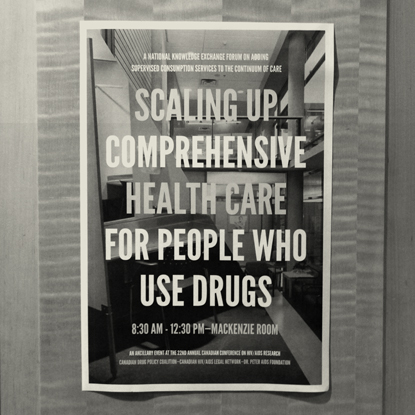
    Voilà la conclusion à laquelle sont venus plusieurs intervenants participant à un événement animé sur la faisabilité de la mise à l’échelle des services de consommation supervisée au Canada, dans le cadre de la récente conférence de l’Association canadienne des soins en sidologie (CAHR) tenue à Vancouver. Parrainé par le Dr Peter Centre, le Réseau juridique canadien VIH/sida et la Coalition canadienne des politiques sur les drogues, cet atelier d’une demi-journée a rassemblé des orateurs d’Ottawa, de Montréal, de Toronto et de Vancouver, en vue de discuter de leurs plans pour la mise à niveau de ces services à-travers le pays.

    Le plus célèbre de ces services est Insite, basé à Vancouver, en Colombie-Britannique. Un grand nombre de preuves provenant d’études effectuées sur Insite suggère que ce service unique comporte plusieurs résultats bénéfiques : il est utilisé par la population qu’il vise à servir, qui inclut plus de 10 000 clients. Et il est utilisé par des gens susceptibles de s’injecter des drogues en public de façon routinière. Ce service a également réduit les comportements à risque en réduisant le partage des aiguilles et en fournissant une éducation sur les pratiques d’injection plus sûres. Insite a favorisé l’inscription à des programmes de traitement pour la toxicomanie et a amélioré l’ordre public. On a également constaté une réduction marquée des décès par surdose, une sûreté accrue pour les femmes qui s’injectent des drogues, et que ce service ne mène pas à une utilisation accrue des drogues ou à une augmentation de la criminalité.[I]

    Mais l’opposition publique et les craintes politiques entravent toujours la mise à l’échelle de ces services. En dépit des avantages bien documentés, les opposants affirment toujours que ces services « favorisent » la consommation de drogues illicites. Ces déclarations s’appuient sur la prémisse erronée que la faute de fournir des services de santé aux gens qui consomment des drogues suffit à dissuader les gens de consommer des drogues. Tout ceci ne contribue qu’à éloigner les gens des soins de santé et à promouvoir des pratiques d’injection moins sûres pouvant mener à des blessures, à des infections et à la mort. Ces opposants ne comprennent pas que ces services favorisent l’engagement envers les soins de santé des populations difficiles à atteindre et protègent la dignité des personnes qui consomment des drogues en donnant priorité à leurs préoccupations de santé.

    L’opposition officielle du gouvernement fédéral a bloqué la mise en oeuvre de ces services salutaires, même en Colombie-Britannique. En 2007, le gouvernement fédéral a refusé de maintenir l’exonération légale accordée à Insite (Section 56 de la Loi réglementant certaines drogues et autres substances (CDSA)). Les partisans du site, y compris la PHS Community Services Society, VANDU, et la Vancouver Coastal Health, ont contesté ce refus jusqu’à la Cour suprême du Canada. En 2011, la Cour a statué en faveur de l’exonération, notant le droit des personnes à accéder à ce service de santé, et a ordonné au ministre fédéral de la santé d’accorder le maintien de l’exonération. Les sites futurs devront faire une demande d’exonération en vertu de la Section 56, afin d’éviter toute accusation criminelle pour violation de la CDSA.

    Il semble que le processus d’application pour demande de dérogation à la Section 56 sera onéreux. En raison de ces difficultés, certains intervenants à la Conférence de l’ACRV ont exhorté le public à envisager d’autres options, telles que des sites non autorisées moins dispendieux utilisant des modèles de soins administrés par des pairs.

    Le besoin est clair – la volonté existe – les résultats sont connus.  Exigeons du gouvernement fédéral qu’il facilite l’accès à ces services, afin que nous puissions sauver des vies, prévenir les maladies et protéger la dignité des personnes qui consomment des drogues.

  • Les peuples autochtones du Canada seront les premiers à souffrir des peines minimales obligatoires imposées pour les crimes liés à la drogue

    Les peuples autochtones du Canada seront les premiers à souffrir des peines minimales obligatoires imposées pour les crimes liés à la drogue

    En début avril, le ministre provincial de la santé de la Colombie Britannique a publié un rapport annonçant que les changements récents apportés aux peines minimales et autres pratiques judiciaires, découlant de la mise en application de la Loi sur la sécurité des rues et des communautés (LSRC) , auront des effets très négatifs sur la santé des peuples autochtones – les changements apportés par la LSRC, tels que les peines minimales obligatoires, mèneront à l’incarcération d’un plus grand nombre d’autochtones.

    Ce rapport note également que la LSRC semble contraire aux autres programmes fédéraux visant à réduire le temps d’incarcération, notamment avec la section 718.2 (e) du Code Criminel, qui exige que les juges prononçant les peines prennent en considération toutes les options autres que l’incarcération. [I]

    L’imposition de peines minimales obligatoires va à l’encontre de la preuve de leur inefficacité. La condamnation des personnes accusées de crimes liés à la drogue ne réduit pas les problèmes liés à l’utilisation de drogues et ces condamnations ne découragent pas la criminalité. [II]

    La surreprésentation des autochtones dans le système carcéral du pays fait la honte nationale, et et son inévitabilité rend celle-ci d’autant plus inquiétante. En 2011, environ 4% de la population canadienne était autochtone, alors que 21,5% de la population fédérale en milieu carcéral était autochtone. Depuis 2006-07, la population autochtone en milieu carcéral a connu une augmentation de 43% et le tiers des femmes sous responsabilité fédérale est autochtone. Dans les Prairies, les peuples autochtones représentent plus de 55 % de la population totale incarcérée au pénitencier de la Saskatchewan et 60 % de la population du pénitencier de Stony Mountain au Manitoba. Les taux provinciaux sont encore pire ; 81 % des personnes incarcérées dans les établissements provinciaux en Saskatchewan étaient des autochtones en 2005.[iii]

    Comme le soutient le ministre provincial de la santé de la Colombie Britannique dans son rapport, les raisons de la surreprésentation des peuples autochtones en milieu carcéral sont multiples, mais elles sont enracinées dans les causes historiques, telles que le colonialisme, la perte de culture, et la marginalisation économique et sociale des autochtones par les citoyens canadiens de race blanche.

    Ces préoccupations ont été reprises dans un rapport d’octobre 2012 publié par l’enquêteur correctionnel du Canada intitulé Une question de spiritualité : les Autochtones et la Loi sur le système correctionnel et la mise en liberté sous condition (ADRC, 1992).[iv]. Ce rapport témoigne du manque de volonté de la part du Service correctionnel du Canada (SCC) relativement au respect des engagements pris dans le cadre de l’ADRC. L’ADRC contient des dispositions spécifiques aux autochtones, visant à favoriser la participation des communautés autochtones au système correctionnel et à adresser le problème de surreprésentation chronique des autochtones au sein du système correctionnel fédéral. Parmi ces exigences figurent l’établissement de pavillons de ressourcement qui soulignant les croyances et traditions autochtones, et mettent l’emphase sur la préparation à la remise en liberté.[v]

    Le rapport a constaté que, en Colombie-Britannique, en Ontario, au Canada Atlantique et du Nord, il n’existe aucun pavillon de ressourcement pour les femmes autochtones. En outre, du fait que l’accès aux pavillons de ressourcement est limité aux détenus à sécurité minimale, 90% des détenus autochtones ne seront pas pris en considération pour transfert vers des pavillons de ressourcement. Le rapport se termine par une critique de l’inaction du Service correctionnel du Canada: « Conformément aux expressions d’autodétermination autochtone, les Sections 81 et 84 capturent la promesse d’une nouvelle définition du rapport entre les peuples autochtones et le gouvernement fédéral. Un contrôle sur plusieurs aspects de la planification de la remise en liberté pour les détenus autochtones, ainsi qu’un accès élargi à des services et à des programmes adaptés à la culture autochtone étaient à l’origine de la création de l’ASRC en novembre 1992.  » [vi]

    Les implications des changements apportés par le gouvernement conservateur aux pratiques de détermination de la peine sont claires : une hausse du taux d’incarcération des autochtones et une augmentation des problèmes liés à la consommation de drogues, combinées à un manque d’engagement envers les voies de guérison alternatives, signifie qu’un nombre accru de contrevenants autochtones sous responsabilité fédérale et provinciale se retrouvera dans les prisons canadiennes, où ils ne recevront pas les services dont ils ont besoin.